
Humanoid Robots in Small UK Flats: Space-Saving Solutions
UK homes are smaller than American ones. Which robots work in tight spaces? Size comparisons, navigation in small rooms, and storage tips.
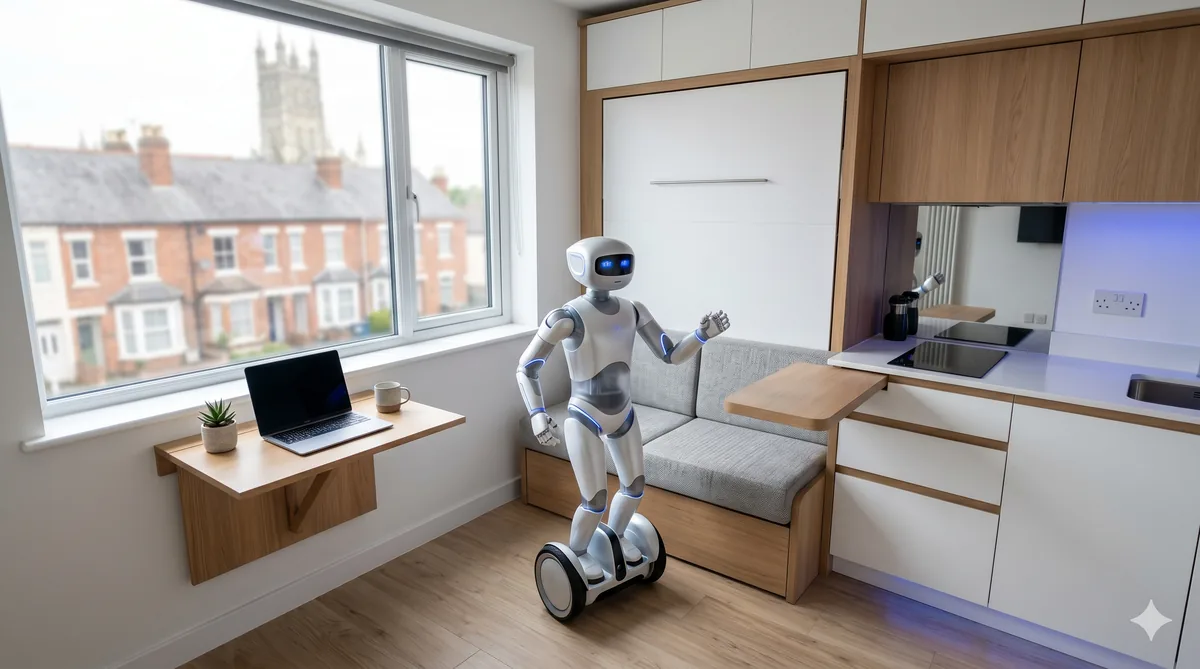
British homes are not built for robots. The average UK flat measures somewhere between 50 and 76 square metres — considerably smaller than the American homes where most humanoid robots are designed and tested. If you live in a one-bedroom flat in London, a converted Victorian terrace in Manchester, or a modern new-build apartment in Birmingham, the question is not just which robot to buy, but whether a humanoid robot can physically operate in your space at all.
The honest answer is: some fit brilliantly, some fit awkwardly, and one or two simply do not fit at all. This guide covers the practical realities of living with a humanoid robot in a small UK home — dimensions, doorways, storage, noise, and which models genuinely work in tight spaces. If you are still deciding which robot to buy, our best humanoid robots for home use guide is a good starting point.
Robot Dimensions: The Numbers That Matter
Before anything else, you need to know whether a robot will physically fit through your doors and move around your rooms. Here is a comparison of the humanoids UK buyers ask about most, with the dimensions their makers publish. Where a maker does not publish a figure, we say so rather than guess.
| Robot | Height | Weight | Width (maker’s figure) | Charging |
|---|---|---|---|---|
| NOETIX Bumi | 94 cm | 12 kg | Not published | Not published |
| Unitree R1 | 123 cm | About 27-29 kg | 357 mm | Quick-release battery |
| Unitree G1 | 132 cm (69 cm folded) | About 35 kg | 450 mm | Quick-release battery |
| 1X NEO | 168 cm | About 30 kg | Not published | Not published |
| NEURA 4NE1 | 180 cm | 80 kg | Not published | Not published |
| Unitree H2 | 182 cm | About 70 kg | 456 mm | Not published |
No maker publishes a minimum operating space, the clear area a robot needs around itself to move and turn without hitting furniture or walls. In a small flat that matters more than height, so plan generous clear space around the robot’s routes and check with the seller before you buy.
The Doorway Problem
Standard UK internal doorways are 762 mm wide. That is the measurement between the frame edges, and it has been the building standard for decades. It is also remarkably narrow when you consider that a humanoid robot needs clearance on both sides to pass through without scraping walls or catching on door frames.
NOETIX does not publish the width of the NOETIX Bumi, but at 94 cm tall it is child-sized. The Unitree R1, 357 mm wide according to Unitree, leaves roughly 20 cm per side in a 762 mm doorway. The Unitree G1, at 450 mm, leaves about 15 cm per side: tight but workable.
1X does not publish NEO’s width. At 168 cm it is adult-sized, so expect less margin than with the smaller robots, and measure your narrowest doors before you plan its routes.
The Unitree H2 is the real concern. Unitree lists it at 456 mm wide, so it fits through a 762 mm doorway on paper, but at 1.82 m and about 70 kg it needs clear, wide routes to move safely. If your door frames are narrower than standard, as is common in older properties, Victorian conversions and some ex-council flats, or your hallways are tight, plan its routes carefully before buying. The H2 is built for larger spaces and struggles in the typical British home layout.
Navigating Cluttered Spaces
Small flats are rarely tidy. Shoes by the door, coats on hooks at robot height, a drying rack in the hallway, shopping bags on the kitchen floor — this is the reality of compact urban living, and it matters enormously for robot navigation.
Robots that use LiDAR and depth cameras for mapping, such as the Unitree G1, are better equipped for clutter than those relying on simpler sensors. NOETIX does not publish how Bumi maps a room, but its small size means it can pass through gaps that larger robots cannot attempt.
Full-sized humanoids like the NEO and H2 need more generous pathways. If your hallway doubles as coat storage, or your living room is dominated by a sofa, coffee table, and TV unit with barely a metre of walking space between them, a 168 cm robot will feel like an unwelcome guest at a crowded party. As a rule of thumb, we would want at least 80 cm of clear pathway for the NEO and 100 cm for the H2. These are our suggestions, not manufacturer figures, and worth checking with a tape measure before you commit.
For detailed setup advice including room mapping and obstacle configuration, see our setup guide.
Storage When Not in Use
A humanoid robot does not fold up and slide under the bed. When it is switched off or charging, it still occupies floor space, and in a small flat that space is at a premium.
The Bumi is the easiest to store. At 94 cm and 12 kg, it can stand in a corner or tuck behind a sofa. The R1, at 123 cm and 27 to 29 kg, is heavier and more awkward but can still be positioned in a corner or alcove. It uses a quick-release battery, so you also need a spot for the charger.
The G1 and NEO start to demand dedicated floor space. You will want a specific spot — a corner of the living room, a section of the hallway, or a cleared area in a bedroom — where the robot lives when not active. Factor this into your furniture layout before buying.
Unitree does not publish a docking station size for the H2, but a 1.82 m, 70 kg robot needs a dedicated parking and charging area with clear space around it. In a small flat, that can mean losing a wardrobe’s worth of floor space. This alone makes the H2 impractical for most compact living situations.
Charging Station Placement
Every robot needs a charging station, and where you put it matters more than you might expect. The key considerations for flat dwellers are:
- Proximity to a power socket. Trailing cables across walkways are a trip hazard in any home, but especially in small flats where every square metre is a thoroughfare.
- Clear access. Several of these robots use a removable battery and a separate charger rather than a self-docking station. Either way, keep the charging spot clear of furniture so you, or the robot, can reach it easily.
- Away from heat sources. Radiators, underfloor heating vents, and south-facing windows can affect battery health over time. A cool, ventilated spot is ideal.
- Out of high-traffic areas. A charging dock in the middle of a hallway will be kicked, tripped over, and bumped by every person who passes. Behind a door or beside a piece of furniture works better.
Noise in Shared Walls and Flats
If you live in a flat with shared walls, floors, or ceilings, noise is a genuine consideration. Humanoid robots are not silent. Servo motors whir, actuators hum, and footsteps on hard flooring create vibration that can transmit through building structures.
Of these makers, only 1X publishes a noise level: it quotes 22 dB for NEO. NOETIX and Unitree do not publish noise figures for Bumi, the R1, the G1 or the H2. As a general rule, smaller and lighter robots make less impact noise when they walk on hard floors.
The H2 is the heaviest of the Unitree humanoids at about 70 kg, so its footsteps are the most likely to be heard in the flat below if you live above someone. We would strongly recommend a thick rug or carpet in the robot’s primary operating area if you choose a larger model in a flat setting.
For all robots, we suggest limiting autonomous operation to daytime hours if you share walls. Most companion apps allow you to schedule active and rest periods, and your neighbours will thank you for using them. Our safety guide covers scheduling and operational boundaries in more detail.
Which Robots Work Best in Small Spaces
Here is our honest ranking for small-space suitability:
NOETIX Bumi - Excellent. The clear winner for small flats on size alone. At 94 cm and 12 kg, it is the smallest and lightest here and stores easily, although it has no UK retailer yet. Its limited practical capabilities are a trade-off, but for education, companionship, and entertainment in a one-bedroom flat, nothing else comes close.
Unitree R1 - Good. The R1’s 123 cm height and 357 mm width make it manageable in most UK flats. It fits through a standard 762 mm doorway with clearance to spare, although it still needs clear floor space to walk safely. If you want genuine agility and mobility in a small space, the R1 is the pick.
Unitree G1 - Acceptable. The G1 suits larger flats better than studio or one-bedroom spaces. It folds down to 69 cm for storage, but the 35 kg weight and 450 mm width mean you need to be more deliberate about furniture layout and operating paths.
1X NEO - Challenging. The NEO is designed for homes, but 1X only takes US orders for now, and its 168 cm height and human-like proportions mean it needs room to work. In a spacious two-bedroom flat with an open-plan layout, it can function well. In a typical one-bedroom flat with a narrow hallway and separate kitchen, you will feel the squeeze.
Unitree H2 - Not recommended for small spaces. The H2 is a professional platform, and a small UK flat is not its setting. Its 1.82 m height, about 70 kg weight and the space it needs to move all work against it. In a typical flat, look elsewhere.
Tips for Flat Dwellers
If you are committed to bringing a humanoid robot into a compact UK home, these practical tips will smooth the experience:
- Measure every doorway. Do not assume they are all 762 mm. Bathroom doors are often narrower, and older properties vary wildly. Add your chosen robot’s published width plus at least 20 cm of clearance and compare.
- Map your walking paths. Walk the routes your robot will take most often — kitchen to living room, hallway to bedroom, dock to main operating area. If you have to turn sideways or step over something, the robot will struggle too.
- Declutter at robot height. Coat hooks, low shelving, and protruding furniture at 90-170 cm height are collision risks. Consider wall-mounted solutions that sit above the robot’s sensor envelope.
- Use scheduling aggressively. Programme the robot to perform tasks when you are out or in another room. A small flat feels smaller when you are sharing it with an active robot.
- Consider carpet or rugs. Soft flooring absorbs footstep vibration and reduces noise transmission to neighbours below.
Leasehold and Freeholder Considerations
If you own a leasehold flat or rent from a housing association, check your lease terms before purchasing a heavy humanoid robot. Some leases contain clauses about heavy equipment, noise restrictions, or modifications to electrical installations. A charging station hardwired to a dedicated circuit could technically require freeholder consent in some buildings.
For rented properties, your tenancy agreement may restrict the use of items that could damage flooring or generate excessive noise. While no UK court has tested these clauses against a domestic robot, it is worth raising the matter with your landlord or management company before a robot costing thousands of pounds arrives at your door.
Insurance is another factor. Standard home contents policies may not cover a humanoid robot, and your buildings insurance might query liability if a robot damages communal areas. Check with your insurer and get confirmation in writing. Our regulations and legal guide covers the broader legal landscape for robot owners in the UK.
Final Thoughts
Living in a small UK flat does not disqualify you from owning a humanoid robot, but it does narrow your options significantly. The Bumi and R1 are genuinely practical choices for compact homes. The G1 works with careful planning. The NEO requires a generous flat layout, and the H2 belongs in a house. Measure first, imagine the robot in your daily routine, and choose the model that fits your home as it actually is, not as you wish it were.